
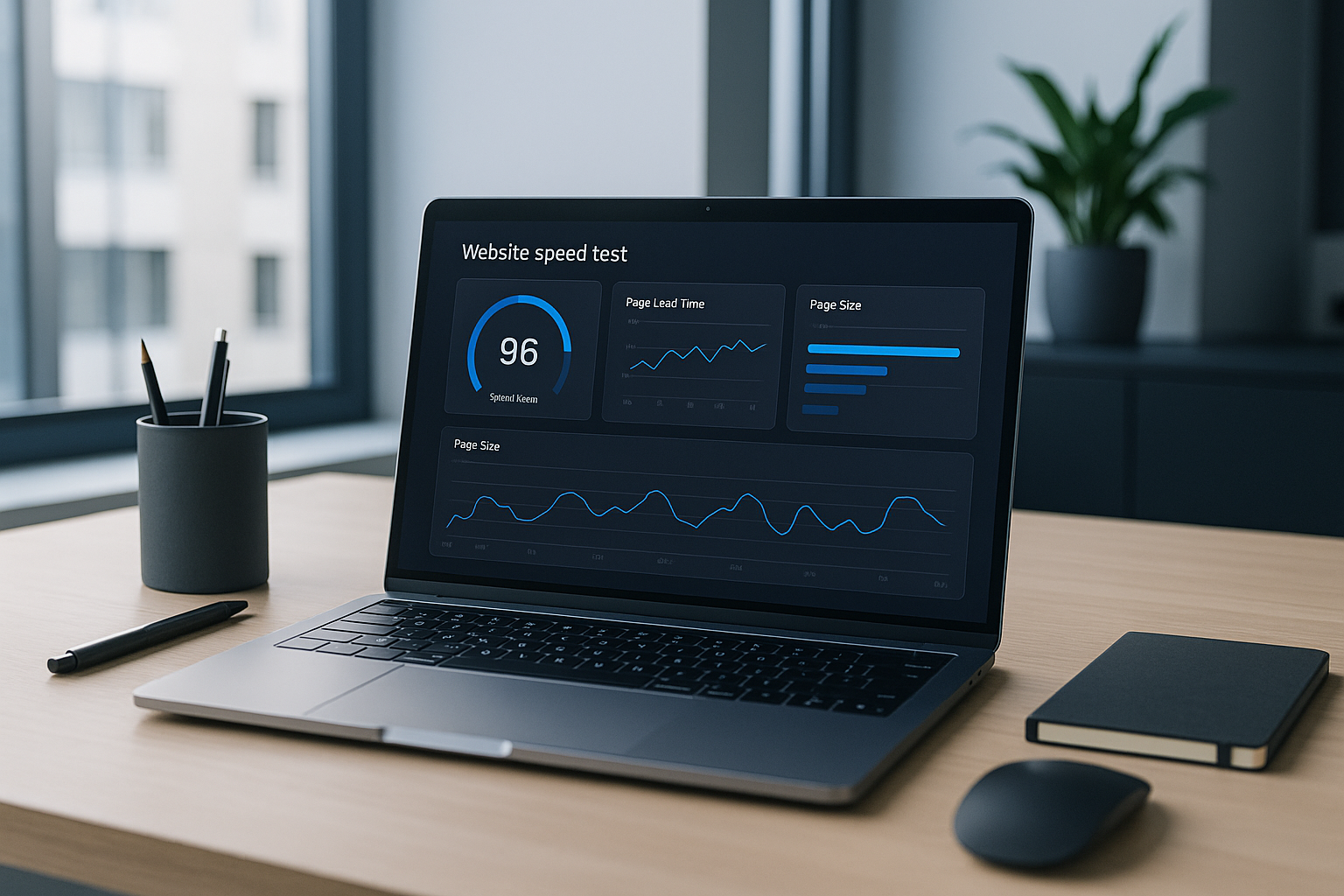
Website speed is one of the ranking factors Google actually measures, and it directly impacts a user's willingness to stay on your site. According to Ahrefs data from September 28, 2026, there are about 300 monthly searches in Israel for the term website speed, with a keyword difficulty of 17 out of 100. In this guide, we explain how to test website speed, how it fits into website optimization, and what can actually be fixed with planned work.
- 300 monthly searches in Israel for 'website speed', keyword difficulty 17 out of 100 according to Ahrefs.
- Google defines three measurable goals for website speed: content loading time up to 2.5 seconds, interaction response time up to 200 milliseconds, and visual stability up to 0.1.
- The first-page results for this term are free tools from Google rather than service pages, indicating that the search intent is primarily informational.
- Real speed improvement requires a technical diagnosis rather than just installing a plugin, as delays usually stem from heavy images, slow hosting, and unoptimized code.
Table of contents
Why website speed affects ranking
Website speed has been an official Google algorithm ranking factor since 2021, as part of the Core Web Vitals family. A slow-loading site, even with excellent content, loses users before they even see it, and cumulative behavior data shows that bounce rates spike with every additional second of loading time.
The connection between speed and overall SEO strategy
A site that meets Google's metric requirements gets a slight ranking advantage, but this advantage does not stand alone. Speed is also the primary factor affecting bounce rate, and therefore impacts conversion rates and contact form leads.
The three key metrics: Core Web Vitals
| Metric | What it measures | Good threshold |
|---|---|---|
| LCP (Largest Contentful Paint) | Loading time of the largest element on the screen | Up to 2.5 seconds |
| INP (Interaction to Next Paint) | Response time to user interaction | Up to 200 milliseconds |
| CLS (Cumulative Layout Shift) | How much elements shift during loading | Up to 0.1 |
| Keyword difficulty for 'website speed' (Israel) | On a scale of 0 to 100 | 17 out of 100 |
Source of the thresholds: official Google web.dev standards for Core Web Vitals; volume and ranking difficulty data from Ahrefs, checked September 28, 2026.
How to actually test website speed
The most official and accurate tool for measuring actual speed is Google PageSpeed Insights, which provides a score from 0 to 100 for mobile and desktop, along with a detailed breakdown of each metric and optimization recommendations. You should check both desktop and mobile, as the data usually differs significantly, and on most sites, the mobile score is lower than the desktop score.
Lab Data vs. Field Data
Lab data shows a one-time result from a single test, while field data is collected from real users who visited the site in recent months. Google relies primarily on field data for ranking, so a lab improvement that doesn't reflect real user experience won't always boost SEO.
What to do with the test results
Running one report and moving on is not enough. The test should identify the three heaviest resources, rank them by file size, and verify if handling them improved the result. Re-measuring with the same tool after every change is the only way to verify that the fix worked. You should prioritize field data from real users so your next step is based on facts, not guesses.
Beyond the score: what the data actually tells you
Beyond the overall score, you should open the full report to see which specific metrics exceed the threshold and which resources meet the requirements. A page that passes with a 90 on desktop but fails on mobile still needs specific attention before business metrics change. Weekly or monthly testing catches recurring issues early and shows if previous fixes held up. Business owners expecting an immediate jump in the overall score might be disappointed, as real improvement in the metrics that actually affect users takes several weeks of focused work. The final step is linking performance data directly to measurable business results. Website speed is one part of a larger picture, working alongside content, structure, and links to achieve stable rankings. This is the difference between a page that looks good and one that actually converts.
What usually slows down websites in Israel
Three factors repeat constantly: heavy, uncompressed images, too many plugins loading render-blocking JavaScript and CSS files, and web hosting that isn't optimized for the traffic load.
Unoptimized images
Original images uploaded directly from a camera in an unoptimized format are the most common cause of slow LCP. Proper compression and using WebP format reduce file size immediately.
Slow hosting and plugin bloat
A WordPress site with 30 active plugins and cheap shared hosting will almost always load slowly, even if individual pages seem fine. Moving to dedicated hosting and removing unnecessary plugins is usually the most effective step for speed optimization.
Unused code and third-party scripts
One of the most common issues on WordPress sites is adding third-party scripts without checking their impact: social media widgets, embedded videos, customer service chats, and tracking tools. Each script loads from an external server beyond the developer's control, and when they accumulate, they can slow down INP even on a site built for speed.
What it means for businesses paying for traffic
A business that invests in SEO and attracts traffic from Google, but loses visitors because of a slow page, is paying for visitors who never become customers. Website speed is not a one-time project, but a maintenance task that requires re-testing at least once a quarter, especially after a major update or design change. Web performance research shows that bounce rates increase measurably with every second of loading delay.
When to re-test
A page that was tested once and received a good score won't stay fast forever. A business owner who publishes content, adds pages, introduces new services, or changes hosting must re-test their website speed and never assume one fix guarantees long-term performance.
Want to check and fix your website speed?
SGO works with hundreds of clients in Israel, testing and improving website speed as part of a full SEO strategy.
Where the data in this article comes from
Volume and difficulty data are sourced from Ahrefs, and Core Web Vitals thresholds come from Google's official documentation at web.dev. Both sources are product-independent, and any page can be measured against these standards.
Frequently asked questions
What is considered a good website speed according to Google PageSpeed Insights?
A mobile score of 90 or higher is considered very good, but the most important metric is staying within the good range for the three Core Web Vitals (LCP, INP, CLS) based on real-world field data.
What is the difference between LCP, INP, and CLS?
LCP measures how fast the largest content on the screen loads, INP measures how quickly the site responds to a click, and CLS measures visual stability during loading. Together, they define the user experience.
Can fast hosting solve speed issues?
Sometimes, but not always. Fast hosting helps, but heavy images and unoptimized code will continue to slow down the site even on excellent hosting.
How long does it take to improve website speed?
Quick fixes like image compression and formatting can show results within days. Changing web hosting or resolving complex plugin issues can often take weeks.
Is website speed measured the same way on mobile and desktop?
Not always. Mobile connections, operating systems, and device CPU load affect metrics differently, which is why a separate test for each device type is necessary.
What an SGO specialist does to actually improve website speed
Technical audit of field and lab data, image compression and format conversion, managing excess plugins, and re-measuring with actual field data after implementation.
Last updated: September 2026.
Want more customers from your site? SGO specializes in organic SEO that drives traffic and leads.